
What Data Should You Collect From Competitor Product Pages?
Most pricing and category teams already collect competitor product data. The bigger question isn’t whether to collect more data, but which data actually helps explain what’s happening in the market.
A lower price doesn’t automatically require a response. It could be the result of a temporary promotion, limited stock, a different product variation, or a third-party seller trying to clear inventory. Looking at a single data point in isolation can lead to unnecessary price changes or inaccurate competitive analysis.
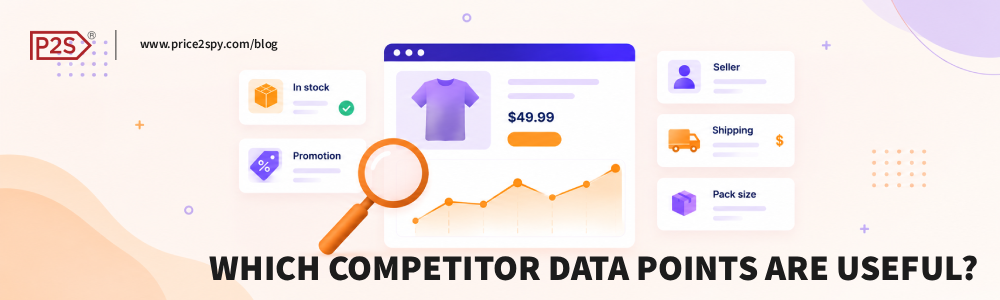
The most valuable competitor insights often come from the context surrounding the data. Stock availability, seller information, shipping costs, packaging, promotions, and product variations can all help explain why competing offers differ and whether those differences should influence your pricing or category decisions.
In this guide, we’ll explore which competitor product data points are worth collecting, when they matter most, and how experienced pricing teams use them to make more informed decisions.
Which Competitor Product Data Points Are Actually Useful?
Effective competitor product research starts with identifying the information that actually supports your decisions. The information that’s valuable to a grocery retailer may have little relevance for a consumer electronics brand, while marketplace sellers often need visibility into data that traditional retailers rarely consider.
The key is understanding which data supports the decisions your team makes every day.
| Data point | What it can tell you | Particularly relevant when |
| Price | How competing offers are positioned and how they change over time | Comparing market positioning and identifying pricing changes |
| Stock availability | Whether an offer is actually available to customers and whether unusual pricing may be connected to inventory | Products have frequent stockouts, seasonal demand, or short life cycles |
| Promotions | Whether a lower price is regular, temporary, or part of a recurring promotional pattern | Promotions are frequent or strongly influence demand |
| Seller information | Who is actually behind an offer | Monitoring marketplaces, authorized retailers or reseller networks |
| Product variations | Whether apparently identical listings refer to the same product configuration | Electronics, fashion, appliances and other variation-heavy categories |
| Packaging and pack size | Whether quantities and unit economics are genuinely comparable | Grocery, FMCG, cosmetics and wholesale |
| Shipping costs | What the customer actually pays to complete the purchase | Delivery costs vary considerably between retailers or markets |
These data points become particularly useful when you analyze them together. A price change tells you that something happened. The surrounding data can help determine what happened, how relevant it is, and whether it requires a response.
When Does Additional Competitor Product Data Change Your Decision?
When Stock Availability Changes the Decision
A competitor lowers the price of a popular product by 15%. If your monitoring stops there, reducing your own price may appear to be the obvious response.
Now add another piece of information: the competitor has very little stock remaining.
That changes the situation considerably. The lower price could reflect an attempt to clear the remaining inventory, particularly if the competitor plans to discontinue or replace the model. Matching it could mean sacrificing margin to compete with an offer that will disappear as soon as customers buy the remaining units.
Availability can also create opportunities in the opposite direction. If several important competitors are out of stock while you still have inventory available, maintaining a higher price may be perfectly reasonable. In this case, following an older competitor price simply because it is lower would ignore the fact that customers can no longer buy the product at that price.
Stock data therefore helps distinguish between an offer that represents the current market and one that exists under temporary inventory conditions.
Before making a decision, ask:
- Is the competitor’s product actually available to buy?
- Has its availability changed around the same time as its price?
- Could the change indicate clearance or discontinuation?
Who Is Actually Selling the Product?
Seller information becomes particularly important on marketplaces and retailer websites where several merchants can offer the same product.
Suppose the lowest offer for a product comes from a third-party seller with a small number of reviews and limited stock, while established retailers and the brand’s authorized partners remain within a much narrower price range. Treating that one listing as the new market price could lead to an unnecessary adjustment.
For brands, the seller’s identity answers another important question: does this price come from a retailer that should be selling the product in the first place? An unusually low marketplace price may point to an unauthorized reseller, grey-market goods, clearance inventory, or another distribution issue that requires a channel management response rather than a pricing response.
For retailers, knowing the seller helps determine how seriously to take the offer when comparing the market. The lowest visible number is not necessarily the competitor that customers consider a realistic alternative.
Questions worth checking include:
- Is the retailer itself selling the product or is it a third-party offer?
- Is the seller relevant to your market and customer base?
- Does the brand authorize the seller?
Are You Comparing the Right Product?
A reliable competitor comparison starts with making sure you’re actually comparing the same products.
A 500 ml product and a 750 ml product obviously shouldn’t be compared using shelf price alone. The same applies to a single item versus a three-pack. In these cases, pack size makes it possible to calculate an equivalent unit price and understand which offer is actually more expensive.
The differences can be less obvious in other categories. Two laptops from the same product line may have different storage or memory configurations. An appliance may come with an additional accessory. A fashion product may have different prices depending on size, color, or material. Retailers may also create exclusive bundles that use similar product names and images while offering something different from the standard version.
These details matter because poor product matching contaminates everything that follows. A perfectly accurate price is still useless for comparison if it belongs to the wrong variant.
Before including two offers in the same comparison, check whether the model, specifications, quantity, pack size and included items are genuinely equivalent.
Promotions Can Change the Meaning of a Price
Consider a retailer that sells a product for €100 most of the month but runs a three-day promotion at €80. A competitor monitoring that retailer during those three days sees a 20% price difference. Without promotion data, there is no way to tell whether the retailer has repositioned the product at €80 or simply launched a short campaign.
The distinction becomes even more important in categories where promotions repeat frequently. Grocery retailers, for example, may rotate discounts across brands and products rather than permanently changing their base prices. Looking at promotional history can reveal whether a competitor tends to discount a product every few weeks, how long those promotions normally last, and whether several retailers are promoting the same category at the same time.
Promotional mechanics matter too. A visible discount may apply only to loyalty members, require a coupon, require purchasing multiple units, or appear only after adding the product to the cart. Two identical displayed prices can therefore represent different offers.
For pricing teams, this changes the question from “Should we match €80?” to “Is €80 the competitor’s new market position, or is it an offer that expires on Friday?”
That distinction can prevent a short promotion from triggering a longer and unnecessary price reduction.
Shipping Costs Can Reverse the Comparison
Product price and purchase cost are not always the same thing.
Imagine two retailers selling the same product:
| Retailer A | Retailer B | |
| Product price | €90 | €95 |
| Shipping | €10 | Free |
| Total customer cost | €100 | €95 |
Retailer A appears cheaper when product prices are compared. From the customer’s perspective, Retailer B offers the lower total cost.
The difference becomes more important for bulky products, cross-border purchases, low-value orders and markets where delivery charges vary considerably. Some retailers may also use free shipping as a competitive incentive instead of reducing the advertised product price.
Shipping costs matter whenever they affect the final amount a customer pays. Depending on the market, you may need to track fixed delivery fees, location-based shipping, free-shipping thresholds, or costs that appear only after customers add a product to the cart.
Ignoring those conditions can make a price comparison technically correct while still misrepresenting the offer a customer actually sees.
How Does Additional Competitor Product Data Tie Into Price Comparison?
Price comparison works best when it compares equivalent offers rather than isolated price values.
That requires answering several questions before deciding which competitor is cheaper or more expensive. Are we comparing the same product? Can the customer actually buy it? Is the displayed price regular or promotional? Who is selling it? What will the customer pay after shipping?
Consider three offers for the same product:
| Competitor A | Competitor B | Competitor C | |
| Product price | €92 | €89 | €95 |
| Availability | In stock | Out of stock | In stock |
| Promotion | No | No | Yes |
| Seller | Authorized retailer | Authorized retailer | Marketplace seller |
| Shipping | €8 | Free | Free |
| Customer cost | €100 | Not purchasable | €95 |
If price were the only criterion, Competitor B would appear to have the strongest offer at €89. In practice, customers cannot buy it. Competitor A is available but costs €100 after shipping. Competitor C, despite having the highest displayed product price, currently offers the lowest purchasable total at €95.
There still isn’t one automatic conclusion from this table. Competitor C’s price is promotional and comes from a marketplace seller, so a pricing manager may decide to monitor the situation rather than immediately match it.
This is where additional competitor product data earns its value. It makes the comparison more accurate and gives the team enough information to decide which differences are worth acting on.
Instead of asking only “Who has the lowest price?”, the comparison can answer more useful questions:
| Instead of asking… | Ask… |
| Who has the lowest price? | Which competitors have genuinely comparable offers? |
| Should we match this price? | What is causing the difference, and how long is it likely to last? |
| Is our product more expensive? | What does the customer actually get and pay for each offer? |
| Has the market moved? | Are several relevant competitors changing, or are we looking at one exception? |
Do All Businesses Need the Same Competitor Product Data?
No. The value of each data point depends heavily on the category, channel, and decision being made.
A grocery retailer dealing with different package sizes may need unit-price comparisons before almost anything else. For a consumer electronics retailer, exact model specifications, stock, and seller information may be more important because visually similar products can differ considerably in configuration.
Brands have another set of priorities. Seeing a product advertised below the expected level is useful, but identifying the seller behind that offer makes the information actionable. Seller identity, stock, and promotional status can help distinguish a widespread channel issue from a single reseller clearing a small amount of inventory.
Marketplace businesses have yet another perspective. When multiple sellers compete on the same product page, seller rating, availability, delivery terms, and shipping can all influence which offer is genuinely competitive.
This is why a useful monitoring setup starts with the decisions a team needs to make, not with the number of fields it is technically possible to collect.
What Should You Prioritize?
Rather than creating one universal priority list, start with the questions that repeatedly slow down or complicate your decisions.
If your team regularly finds a lower competitor price and then manually checks whether the item is available, stock status belongs in your monitoring data.
If analysts spend time opening marketplace listings to determine who is behind unusual offers, seller information is worth collecting.
If your reports repeatedly compare different quantities or configurations, pack size and product variation data need to be part of the comparison itself.
If temporary discounts trigger unnecessary alerts or price changes, promotion status and promotional history deserve more attention.
And if your market has meaningful delivery charges, include shipping when calculating the competitive offer instead of considering it separately.
A useful rule is simple: if your team repeatedly needs to look up another piece of information before it can act on competitor product data, that information is probably worth collecting.
Key Takeaways
Collecting every piece of information available on a competitor’s product page doesn’t necessarily add value. The useful data is the data that changes how you interpret an offer or what you decide to do next.
Stock availability tells you whether an offer is actually competing for the sale. Seller information tells you whose pricing behavior you’re looking at. Product variations and packaging determine whether the comparison is valid in the first place. Promotions help separate temporary activity from longer-term positioning, while shipping costs bring the comparison closer to what the customer actually pays.
Once you know which of these data points matter to your decisions, the next consideration is how consistently you can collect them. Manually checking a few competitor pages may be manageable, but the same process becomes difficult to maintain across hundreds or thousands of products, especially when availability, promotions, sellers, and other details can change frequently. Automating the collection of additional competitor product data makes it possible to apply the same checks across a much larger assortment and, just as importantly, to build a history of how those data points change over time.
That history can be as valuable as the current observation. A promotion seen once tells you what a competitor is doing today. Repeated observations can show whether that promotion follows a pattern. The same applies to recurring stockouts, seller changes, shipping offers, or product variations. Automation therefore isn’t valuable simply because it replaces manual work. It makes this context consistently available for ongoing analysis.
The goal isn’t to collect more competitor product data. It’s to have enough of the right data, collected consistently, to know when a market change deserves your attention and when it doesn’t.