

Customer Journey in eCommerce: The Blind Spots Most Retailers Miss
Most customer journey maps look remarkably similar.
Customer journey maps follow the customer from awareness to purchase, identify key touchpoints, assign emotions to each interaction, and highlight opportunities for improvement. Marketing teams use them to optimize campaigns, customer experience teams to reduce friction, and sales teams to improve conversions.
The problem is that modern customer journeys rarely follow the neat, predictable paths shown in those diagrams.
Today’s customers move between channels, devices, marketplaces, review platforms, and competitors multiple times before making a purchase. They discover products on social media, compare prices on Google Shopping, read reviews on third-party websites, check availability on marketplaces, and often return days or weeks later to complete the purchase.
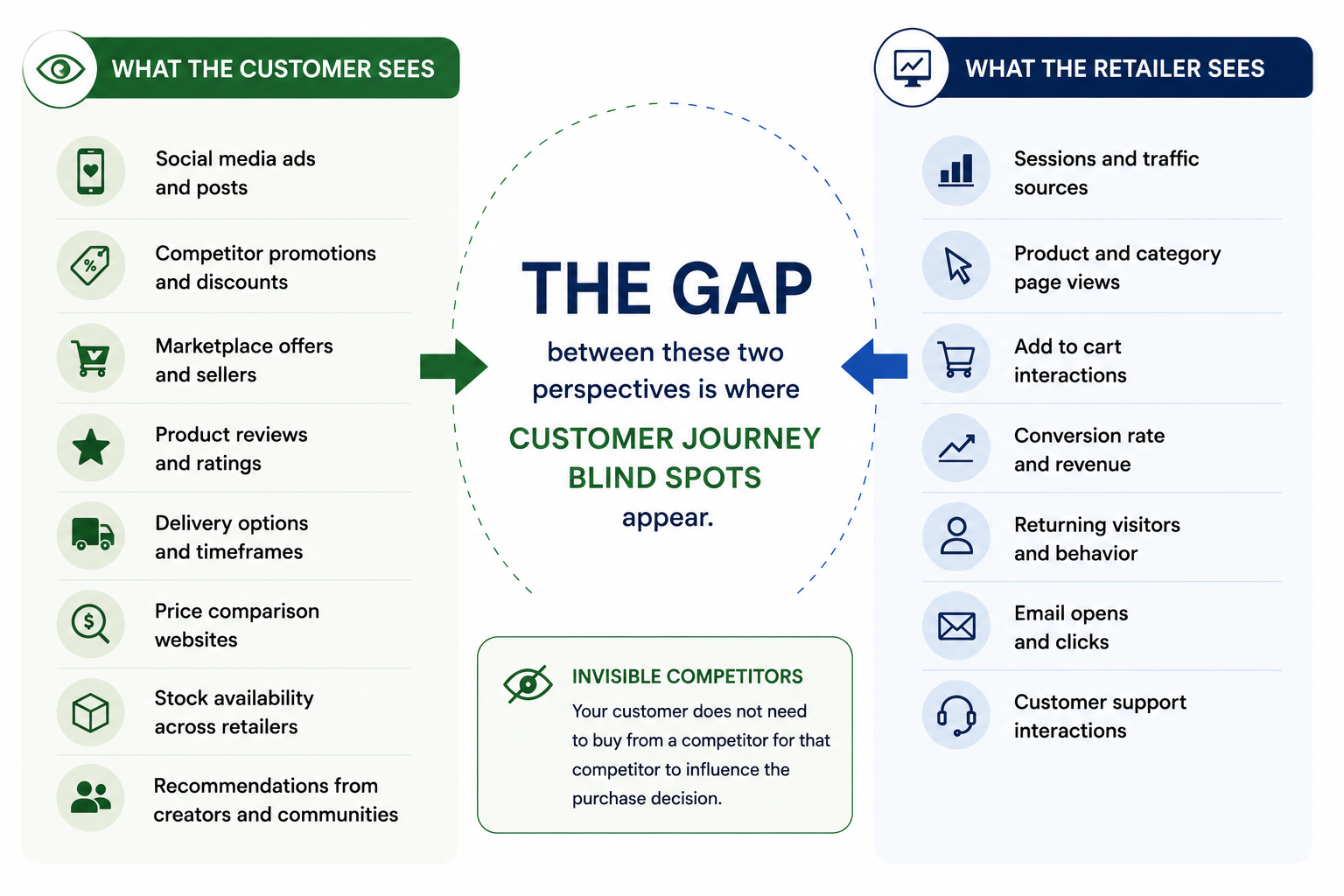
Meanwhile, most retailers only see the interactions happening on their own website.
As a result, many customer journey maps capture only part of the story.
They show what happened inside the company’s ecosystem, but fail to account for the competitive environment that shaped the customer’s decision along the way.
This creates one of the biggest blind spots in modern eCommerce.
What Is a Customer Journey?
A customer journey represents the complete series of interactions a customer has with a brand before, during, and after making a purchase.
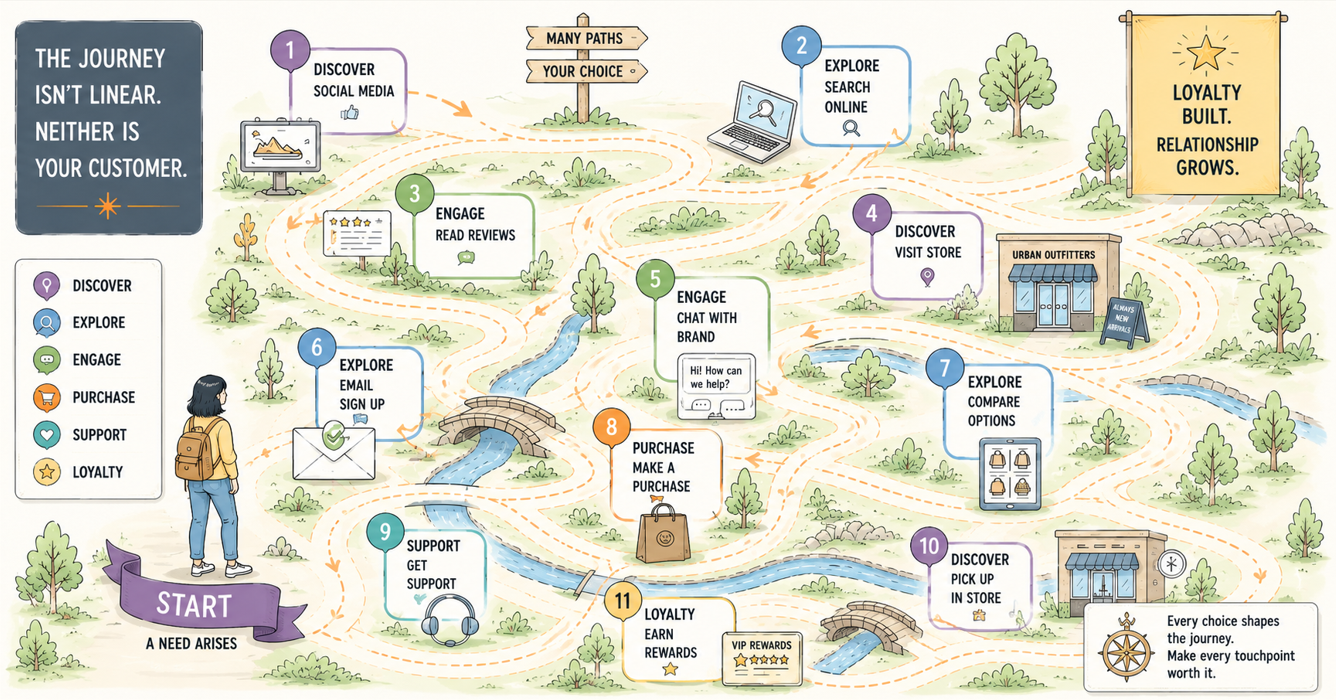
Unlike traditional sales funnels, customer journeys are rarely linear. Customers move back and forth between stages, revisit products several times, compare alternatives, seek recommendations, and switch between channels throughout the buying process.
For eCommerce businesses, a customer journey may include interactions such as:
- discovering a product through social media or search;
- visiting a product page for the first time;
- comparing prices across multiple retailers;
- reading reviews and product specifications;
- abandoning the cart and returning later;
- purchasing through another channel or marketplace;
- engaging with support or loyalty programs after the purchase.
Each interaction influences customer perception and affects the likelihood of conversion.
The challenge for retailers is not simply understanding these touchpoints, but identifying which ones have the greatest impact on buying decisions.
Why Traditional Customer Journey Maps Are Becoming Less Useful
Traditional customer journey maps were designed for a world where customers interacted with a limited number of channels and brands.
That environment no longer exists.
A customer researching a new laptop, television, or coffee machine can easily interact with dozens of websites before making a decision. Search engines, marketplaces, review platforms, price comparison websites, social media, and physical stores all become part of the same buying journey.
The result is a fragmented journey that looks less like a funnel and more like a network of interconnected decisions.
For retailers, this creates an important challenge:
You can optimize only the parts of the journey that you can actually see.
If your customer journey map only includes interactions with your own brand, there is a good chance that some of the most influential moments in the purchase process occur elsewhere.
The Customer Journey Blind Spots Most Retailers Miss
Most retailers build customer journey maps using data they already have access to.
They analyze website behavior, campaign performance, customer feedback, and purchase history to understand how customers move through the buying process.
The problem is that customers make decisions based on far more information than retailers can see in their own analytics platforms.
Some of the most influential moments in the journey often happen outside the brand’s ecosystem.
Competitor Research Happens Earlier Than Most Retailers Think
Customers rarely wait until the final stages of the journey to compare alternatives.
Many begin evaluating competitors immediately after discovering a product category. They compare prices, product specifications, delivery options, reviews, warranties, and promotions long before they are ready to purchase.
By the time a visitor reaches a product page for the second or third time, they may already have a clear understanding of the competitive landscape.
The retailer sees a returning visitor.
The customer sees a shortlist of options competing for their budget.
Marketplaces Influence Decisions Even When Customers Buy Elsewhere
A customer may discover a product on Instagram, research it on a retailer’s website, compare prices on Google Shopping, read reviews on Amazon, and ultimately complete the purchase directly from the brand.
From an analytics perspective, this may appear as a relatively straightforward conversion path.
In reality, several channels and competitors contributed to the final decision.
Ignoring these interactions can result in customer journey maps that overestimate the influence of owned channels while underestimating the role of marketplaces and third-party platforms.
Competitor Promotions Change Customer Expectations
Pricing is rarely evaluated in isolation.
A customer who has recently seen a competitor offering free shipping, bundle discounts, or seasonal promotions is likely to assess your offer against those expectations.
Even if your pricing strategy remains unchanged, the context surrounding the customer may have shifted significantly.
Two customers visiting the same product page can therefore have completely different perceptions of value depending on what they encountered earlier in their journey.
Availability Can Be Just As Important As Price
Retailers often assume that losing a sale means losing on price.
In reality, availability frequently plays an equally important role.
A customer facing long delivery times, stock shortages, or limited product options elsewhere may be willing to pay a premium for immediate availability.
Similarly, out-of-stock competitors can create opportunities that are impossible to identify if customer journey analysis focuses exclusively on internal data.
Customer Journey Touchpoints Extend Beyond Owned Channels
Traditional customer journey maps tend to focus on interactions that companies can directly control.
These usually include:
- paid advertising campaigns;
- website visits;
- product pages;
- email communication;
- customer support interactions;
- loyalty programs.
Modern eCommerce journeys are considerably more complex.
Customers regularly move between owned, earned, and third-party channels throughout the buying process.
Additional touchpoints often include:
- search engines;
- marketplaces;
- price comparison platforms;
- review websites;
- influencer content;
- social media communities;
- competitor websites;
- affiliate publishers.
Many of these interactions leave no trace inside traditional analytics tools, despite having a direct impact on conversion probability.
Understanding this distinction is often the difference between optimizing customer journeys and simply documenting them.
Customer Journey Ownership Extends Beyond Marketing
One of the biggest misconceptions surrounding customer journey management is that it belongs exclusively to marketing teams.
In reality, customer experience is shaped by decisions made across the entire organization.
Marketing influences discovery and acquisition.
Merchandising affects product presentation and assortment quality.
Pricing teams influence competitiveness and perceived value.
Operations determine delivery speed and availability.
Customer support shapes post-purchase satisfaction and loyalty.
When these teams operate independently, customer journeys become fragmented.
The businesses that create the strongest customer experiences are usually the ones that align these functions around shared customer outcomes rather than departmental KPIs.
How to Build a Customer Journey Map That Reflects Market Reality
Customer journey maps should not only explain how customers interact with your brand.
They should also capture the external factors influencing those interactions.
Alongside traditional touchpoints, retailers should consider including:
- competitor activity;
- promotional periods;
- pricing changes;
- stock availability;
- marketplace exposure;
- shipping expectations;
- review sentiment.
This additional context helps explain customer behavior that may otherwise appear irrational.
A sudden drop in conversion rate, for example, may have less to do with website performance and more to do with an aggressive promotion launched elsewhere in the market.
Similarly, an unexpected increase in demand may reflect reduced availability among competitors rather than improvements in campaign performance.
Without this context, customer journey maps risk becoming historical documents rather than decision-making tools.
Subscribe to our newsletter!
Latest pricing news, eCommerce updates and more!
A Realistic eCommerce Customer Journey Example
Consider a customer shopping for a new laptop.
Day one begins with a YouTube review.
Later that evening, the customer searches for specifications and lands on your website for the first time.
The next day, they compare prices on Google Shopping and save several options for later.
A few days pass.
They receive a retargeting ad from one retailer, read customer reviews on a marketplace, and notice that one competitor has temporarily reduced prices.
Another retailer is out of stock.
A third offers free delivery.
Eventually, the customer returns and places an order.
From the retailer’s perspective, the journey may appear surprisingly simple:
- organic search;
- product page visit;
- returning visitor;
- purchase.
The customer experienced something very different.
Their decision was shaped by pricing, availability, reviews, promotions, delivery expectations, and competitor activity across multiple channels over several days.
This difference between what customers experience and what businesses can observe is where many optimization opportunities are lost.
Metrics That Matter Throughout the Customer Journey
Traditional customer journey metrics remain important.
Conversion rate, customer acquisition cost, retention, and customer lifetime value continue to provide valuable insights.
However, they rarely explain why customer behavior changes.
To understand that, retailers often need additional context.
Questions worth asking include:
- How frequently are competitors changing prices?
- Are competitors running promotions more aggressively?
- Has product availability shifted across the market?
- Are shipping expectations changing?
- Are marketplace sellers influencing price perception?
- Is customer research behavior becoming longer or shorter?
These signals rarely appear in customer journey diagrams, despite influencing customer decisions every day.
The Best Customer Journeys Are Built on Context
The companies with the strongest customer journeys are not necessarily the ones with the most sophisticated diagrams or the largest number of touchpoints.
More often, they are the companies that understand the environment in which buying decisions happen.
Customers do not evaluate brands in isolation.
They evaluate alternatives, compare offers, monitor prices, read reviews, and constantly adjust their expectations based on what they see across the market.
The more accurately a business understands that context, the easier it becomes to identify friction, uncover opportunities, and improve customer experiences.
Because in modern eCommerce, the biggest customer journey challenge is rarely understanding your customer.
It is understanding everything happening around them.