
How Retailers Should Adapt Pricing Throughout the Customer Decision-Making Process
Modern consumers rarely follow a simple or predictable path to purchase. They compare products across marketplaces, revisit offers multiple times, evaluate alternatives side by side, and often delay decisions until pricing, timing, or conditions feel right.
For retailers, this creates a growing challenge. Pricing approaches that improve visibility early in the buying journey may become ineffective once customers begin actively comparing alternatives or evaluating overall purchase value.
A shopper casually discovering products during a seasonal promotion behaves differently from a customer actively comparing alternatives minutes before checkout. Likewise, a first-time buyer evaluating multiple retailers has different expectations than a returning customer already familiar with a brand.
This is one of the reasons pricing strategies can no longer remain static throughout the customer decision-making process.
In eCommerce environments, pricing influences far more than final purchase decisions. It shapes:
- product visibility
- competitiveness
- trust
- conversion potential
- long-term customer perception
Understanding how customer expectations evolve throughout the customer decision-making process helps retailers make more informed pricing decisions rather than reacting only after performance begins to decline.
Why Pricing Strategies Must Adapt Throughout the Customer Decision-Making Process
Consumer Decision-Making Process Flow
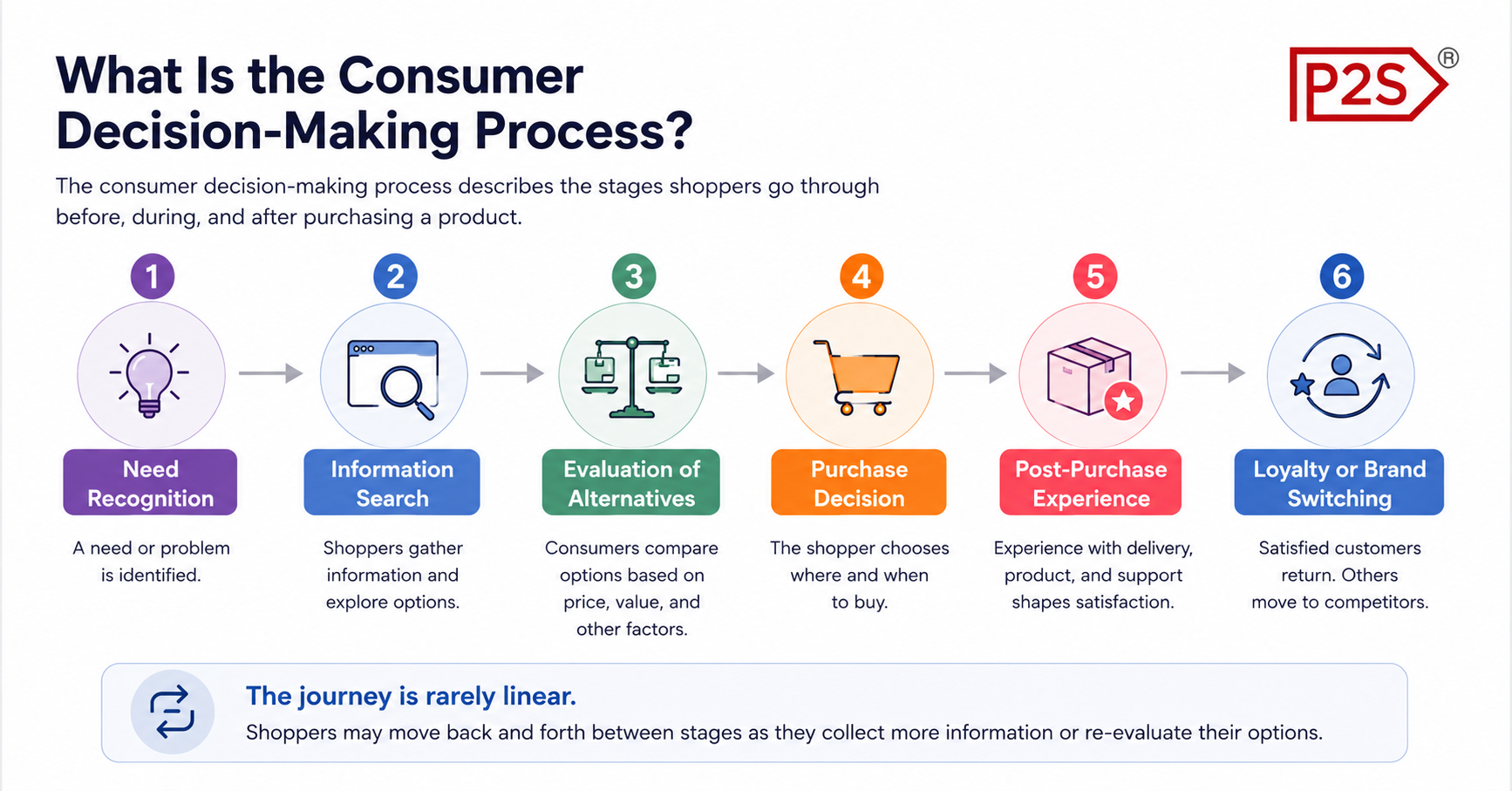
One of the biggest misconceptions in eCommerce pricing is assuming that consumers evaluate pricing the same way throughout the entire customer decision-making process.
In reality, customer expectations change continuously.
During the discovery stage, visibility and competitiveness often matter most. Products that appear prominently during seasonal campaigns, marketplace searches, or promotional periods are more likely to enter the customer’s consideration set early.
Later in the customer decision-making process, shoppers become significantly more selective. Once customers begin actively comparing alternatives, pricing alone rarely determines the outcome. Delivery expectations, trust signals, consistency, and perceived value all begin influencing decision-making alongside product price.
By the time consumers reach checkout, even relatively small friction points can influence whether they complete the purchase or continue searching elsewhere.
This creates a more complex pricing environment for retailers because competitiveness is no longer only about offering the lowest price. It is about understanding what customers expect during different stages of the customer decision-making process and aligning pricing strategies accordingly.
In practice, many businesses still approach pricing too uniformly:
- identical pricing logic across entire catalogs
- reactive discounting
- inconsistent promotions
- short-term competitor reactions
While these approaches may temporarily improve visibility, they often fail to support sustainable positioning over time.
The retailers that perform best are usually the ones adapting pricing strategies based on:
- customer intent
- product visibility
- category volatility
- timing
- competitive context
rather than treating every pricing decision equally.
How Retailers Should Adapt Pricing Throughout the Customer Decision-Making Process
The customer decision-making process gives retailers more than insight into consumer behavior. It also helps identify when different pricing strategies are likely to have the strongest impact.
Subscribe to our newsletter!
Latest pricing news, eCommerce updates and more!
Discovery Stage: Prioritizing Visibility-Driving Products
At the beginning of the customer decision-making process, consumers are usually not comparing entire product catalogs. Instead, they are discovering products through marketplace searches, category pages, advertisements, influencer content, or seasonal campaigns.
For retailers, this creates an important strategic question:
Which products actually shape customer perception early in the journey?
In many industries, a relatively small number of highly visible products influence overall competitiveness far more than the rest of the catalog.
A consumer electronics retailer, for example, may monitor pricing changes aggressively on gaming consoles, smartphones, or premium laptops because these products attract the highest comparison activity. Smaller accessories or low-traffic products may not require equally aggressive adjustments.
This allows retailers to focus pricing efforts where visibility matters most instead of spreading resources evenly across thousands of products.
Retailers also need to consider channel behavior during this stage. Customers browsing marketplaces such as Amazon or Google Shopping often compare prices far more aggressively than shoppers visiting direct-to-consumer stores, where branding, loyalty, or product exclusivity may influence behavior more strongly.
As a result, pricing strategies often differ significantly between marketplaces and retailer-owned channels, even for identical products.
Evaluation Stage: Interpreting Competitive Context Correctly
Once consumers begin actively comparing alternatives, pricing decisions become much more dependent on context.
A competitor lowering prices may initially appear threatening, but pricing alone rarely tells the full story. The competing retailer may:
- have limited inventory
- offer slower delivery
- run temporary marketplace promotions
- target a different region
- discount products with declining demand
Without broader pricing visibility, retailers may respond too aggressively to short-term pricing changes that have little actual influence on purchasing behavior.
Pricing visibility refers to retailers having clear insight into how competitors position products across marketplaces, promotions, and rapidly changing market conditions.
Cross-referencing competitor pricing with additional market conditions helps businesses make more informed decisions during the evaluation stage of the customer decision-making process.
This becomes especially important in volatile industries where pricing conditions change rapidly throughout the week or even throughout the day.
Regional pricing differences also become more relevant during this stage. A pricing strategy that appears highly competitive in one country may feel significantly overpriced in another depending on local competition, delivery expectations, taxes, or marketplace maturity.
Retailers operating internationally often need different pricing approaches across markets instead of applying identical pricing structures globally.
Purchase Stage: Protecting Margins Without Increasing Friction
By the purchase stage, many retailers already compete aggressively for visibility and comparison positioning.
The challenge now shifts toward balancing competitiveness with profitability.
This is where poorly structured discounting strategies often become problematic. Retailers may reduce prices aggressively to secure conversions, only to discover that shipping costs, marketplace fees, or promotional campaigns significantly reduce margins.
Instead of relying exclusively on last-minute discounts, many retailers increasingly focus on reducing friction during checkout:
- clearer delivery expectations
- stable promotional messaging
- consistent pricing across channels
- simplified checkout flows
In many cases, improving purchase confidence has a stronger impact on conversions than additional price reductions.
Inventory conditions also become especially important during this stage of the customer decision-making process.
During high-demand periods, availability may influence purchasing decisions more strongly than relatively small pricing differences. Retailers facing low stock situations may prioritize margin protection instead of aggressive discounting, particularly when competitors already show limited availability.
On the other hand, excess inventory may justify more aggressive pricing adjustments if retailers need to increase visibility quickly before seasonal demand declines.
This is one of the reasons experienced pricing teams increasingly combine inventory awareness with pricing strategy instead of treating them as completely separate operational decisions.
Post-Purchase Stage: Managing Future Pricing Expectations
One of the most overlooked parts of the customer decision-making process is how pricing influences future customer expectations after the purchase itself.
Consumers increasingly remember pricing behavior over time.
If retailers repeatedly rely on aggressive short-term discounting, customers may begin delaying purchases intentionally while waiting for future promotions. Over time, this can weaken long-term pricing power and create growing discount dependency.
This is especially common in categories such as fashion, consumer electronics, or home appliances, where seasonal campaigns occur frequently throughout the year.
Retailers also need to think carefully about pricing consistency after purchase. Significant discounts appearing immediately after checkout may create frustration even when customers were originally satisfied with the purchase.
This is where historical pricing analysis becomes particularly valuable.
Instead of evaluating only short-term conversion performance, retailers can identify:
- promotion fatigue
- seasonal pricing patterns
- discount dependency risks
- recurring competitor behavior
- long-term customer response trends
This helps businesses maintain stronger long-term positioning instead of relying exclusively on short-term promotional spikes to drive revenue.

Why Reactive Pricing Often Fails During the Customer Decision-Making Process
One of the biggest challenges in eCommerce pricing is the speed at which market conditions change throughout the customer decision-making process.
Competitor pricing, promotional activity, inventory availability, and marketplace positioning can shift multiple times throughout the day, especially in highly competitive categories.
However, reacting quickly is not always the same as reacting strategically.
Many businesses still rely too heavily on isolated competitor movements without considering the broader context. A competitor lowering prices on several products may trigger immediate catalog-wide adjustments even when:
- customer demand remains stable
- competitor’s inventory is limited
- visibility impact is temporary
- purchasing behavior remains unchanged
Over time, this kind of reactive pricing often creates unnecessary pricing pressure without meaningfully improving competitiveness.
It can also weaken long-term pricing perception if consumers begin associating the retailer with unstable or unpredictable pricing behavior.
This becomes particularly risky in industries such as consumer electronics or premium beauty, where customers closely evaluate pricing consistency before purchasing.
The strongest pricing strategies are usually not built around reacting fastest to every competitor movement. They are built around understanding:
- which products influence visibility most strongly
- which categories are most price-sensitive
- when customer expectations shift
- which pricing decisions influence long-term positioning
- when maintaining stability matters more than immediate reactions
This requires a much broader view of pricing than simple competitor matching alone.

Using Pricing Intelligence to Understand the Customer Decision-Making Process Better
Ecommerce pricing strategies increasingly depend on interpretation rather than observation alone.
Most retailers already have access to large amounts of market data. The real challenge is understanding which signals actually matter throughout the customer decision-making process.
Historical pricing analysis, for example, can help retailers identify broader behavioral patterns instead of reacting emotionally to isolated market events.
A retailer monitoring pricing trends over time may notice that competitors consistently increase promotional activity several days before major shopping periods. Preparing earlier allows the retailer to remain competitive before visibility and conversion rates begin declining.
Similarly, some categories experience significantly higher pricing volatility than others. Consumer electronics retailers often encounter rapid pricing changes on highly visible products, while categories with lower comparison activity may require far less aggressive responsiveness.
Real-time monitoring also becomes increasingly important in industries where pricing changes frequently throughout the day. Delayed reactions during periods of intense competition can reduce visibility during critical stages of the customer decision-making process, especially while consumers actively compare alternatives.
At the same time, the most valuable insights often come from combining multiple layers of information rather than evaluating pricing changes independently.
A competitor lowering prices may initially appear threatening. However, broader analysis may reveal:
- low inventory availability
- slower delivery conditions
- temporary marketplace promotions
- limited regional visibility
Without that additional context, retailers often risk overreacting to short-term market changes that have relatively little influence on actual customer behavior.
This is why pricing intelligence increasingly focuses less on raw competitor tracking and more on understanding how market conditions influence customer expectations throughout the customer decision-making process.
Why Long-Term Positioning Matters More Than Short-Term Reactions
One of the biggest challenges in modern eCommerce pricing is balancing short-term competitiveness with long-term positioning.
Aggressive pricing adjustments may temporarily improve visibility or conversions, but excessive discounting can gradually weaken pricing power and reshape customer expectations over time.
This becomes especially visible in categories where retailers frequently compete through undercutting strategies. While consistently undercutting competitors may increase short-term traffic, it can also reduce margins, create unstable pricing perception, and encourage customers to delay purchases while waiting for future discounts.
For many retailers, the goal is no longer simply reacting faster than competitors. The goal is understanding which pricing decisions strengthen long-term competitiveness throughout the customer decision-making process without creating unnecessary pricing pressure across the market.