Purchase Decision Process: Sell More by Understanding Your Customers
Making a purchase decision is much more than paying for a product or service. It involves a series of steps before and after the purchase. Understanding this process on a fundamental level means knowing the 5 steps of the purchasing process.
Additionally, knowing how factors such as product information, social proof, pricing, convenience, and branding contribute to a purchase decision enables online retailers to allocate resources into areas with highest returns.
In this article, we will break down the five stages of the purchase decision process and look at the main factors that shape each one.
Purchase Decision Process
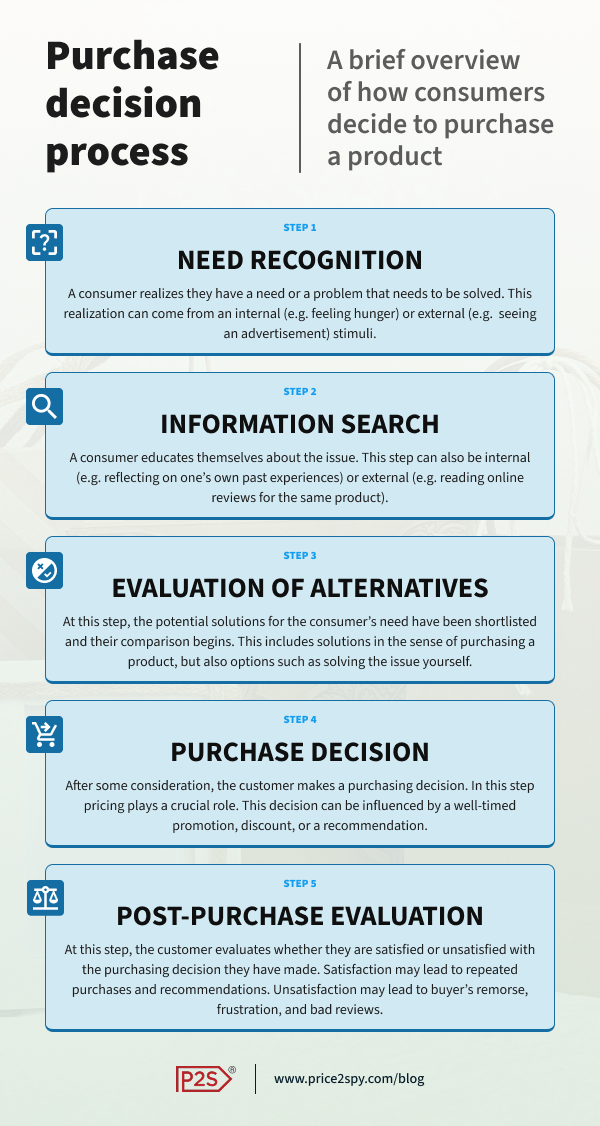
The purchase decision process is the path customers go through when deciding whether to buy a product or not. It involves the following 5 steps:
- Need recognition;
- Information search;
- Evaluation of alternatives;
- Purchase decision; and
- Post-purchase evaluation.
Purchase decision itself is the final choice a customer makes after weighing different options, evaluating relevant factors, and deciding which product or service best fits their needs.
In other words, it is the culmination of the steps leading up to it.
Let’s take a detailed look at the steps of the purchasing process.
Step 1: Need recognition
At this step, the consumer realizes they have a problem that needs to be solved. This realization can be triggered internally (e.g. by feeling hunger) or externally (e.g. by seeing an advertisement).
In other words, need recognition is the step at which a customer realizes there is a gap between their current situation and a desired one. In some cases, that need can be understood through broader frameworks such as Maslow’s hierarchy of needs, which groups human needs in following tiers:
- Physiological needs;
- Safety needs;
- Love and belonging;
- Esteem needs; and
- Self-actualization needs.
The urgency of that need can vary. Some needs require an immediate response, while others can be postponed.
What does need recognition look like in practice? Here are a few examples:
- “My laptop is too slow, I can’t finish my tasks in time anymore.”
- “These shoes look like they’ll break down this winter. I need new ones.”
- “Urghh. This phone can’t even make it through the day on a single charge anymore.”
Now that the need has been recognized, the customer starts thinking about how that need can best be met. This usually leads to the information search stage, where they begin exploring products, brands, or services that could solve the problem.
Step 2: Information search
Once the need has been recognized, the consumer educates themselves about the issue. This process can also be internal (calling up on previous experiences) or external (e.g. asking friends, looking up solutions online, etc.).
At this step, after the research, usually the need from the previous step becomes a want.
What does this mean?
It means shifting the consumer’s mindset from focusing on the problem to wanting a specific solution to their problem.
Depending on the problem, the consumer can potentially solve it by themselves, ask a friend or a close person, postpone the resolution, change their perspective, or decide to make a purchase that will fulfill their need.
If a customer decides they should make a purchase, they move on to the next step, where they evaluate all the available options. This is why the right content during the research phase matters, especially when it can surface in AI overviews and search results where consumers look for solutions to address their problems.
Step 3: Evaluation of alternatives
At this step, the potential solutions for the customers’ needs have been shortlisted, and their comparison begins.
Pros and cons of each product, seller, or brand are evaluated against the following criteria:
- Price,
- Product features,
- Quality,
- Reviews and ratings,
- Brand reputation,
- Availability,
- Delivery conditions,
- Return policy,
- Ease of purchase.
The importance of each factor depends on the type of product, the urgency of the need, and the customer’s personal preferences.
Let’s take a look at an example of a mobile phone. A customer notices their current one is either too slow, battery doesn’t last long, there are no more updates for it, or they simply think it’s outdated. Depending on what their problem is, they will start comparing alternatives. They may look at processing power, battery capacity, design, camera quality, display quality, or any other characteristic relevant to them. Note that in a large majority, if not all, of the cases they will also look at the price, regardless of the specific problem.
Once the customer has compared the available options and formed a preference, they move closer to making the final purchase decision.
Step 4: Purchase decision
After some consideration, the customer makes a purchase decision.
A positive purchase decision means the customer decided to make a purchase, and a negative purchase decision means they have decided to address their problem from Step 1 in a different way.
An important thing to note is that there’s still room for influencing the decision during this step. Well-timed promotions, discounts, and recommendations from trusted sources can play a pivotal role in this step.
At the same time, obstacles such as high shipping costs, poor return conditions, low trust in the seller, or a complicated checkout process can just as easily discourage them from completing the purchase.
In other words, this step is where intention turns into action, but also where hesitation can still prevent the sale from happening. A nudge in the right direction can go a long way. Here are some examples of actions that can go a long way:
- A mail with a notification about an abandoned cart;
- Short-lasting discount;
- Short-lasting free delivery option;
- A recommendation from a trusted source.
Once the purchase has been made, the customer moves into the post-purchase evaluation stage, where they reflect on whether they made the right choice.
Step 5: Post-purchase evaluation
This step comes after a positive purchase decision. In case of a negative purchase decision, customers usually return to one of the previous steps.
Post-purchase evaluation can be satisfactory, potentially leading to repeated purchases or recommendations. On the other hand, it can also be unsatisfactory, leading to buyer’s remorse, frustration, and potentially bad reviews.
The questions customers usually ask themselves after a purchase are:
- Did this product or service I purchased solve my initial problem?
- Did I overpay? Was it worth the money?
- Did I have any issues while ordering, paying, or waiting for the delivery?
- Would I buy this again?
- Would I recommend it to someone else?
- Do I feel any regrets at all?
Depending on the answers, there are a few possible outcomes:
- Brand loyalty and evangelism;
- Repeated purchases;
- Satisfaction;
- Neutral acceptance;
- Complaint or return;
- Buyer’s remorse; or
- Negative review.
At this step it becomes clear why understanding the whole purchase decision process is important for online retailers. Positive evaluations lead to repeated purchases and potentially even more customers which lead to business growth. On the other hand, negative experiences hurt your brand and its reputation, lead to fewer purchases, and can even deter new customers from coming in.
The Most Important Factors that Influence Purchase Decisions
Although the purchase decision process tends to follow the same general stages, the outcome is shaped by a range of factors. Depending on the product, situation, and customer, some of these may carry more weight than others.
Pricing
In highly competitive industries where product differentiation is low, product pricing plays a major role in purchase decisions. When customers see little difference between available options, they often lean toward the cheapest one.
However, this is not always the case. In many categories, customers are not simply looking for the lowest price, but for the option that offers the best value for money. Skincare products are a good example, as purchase decisions are often influenced by effectiveness, safety, and whether the product feels worth its price.
The role of pricing in purchase decisions is even more than a value signal. It is often one of the key factors customers use to compare alternatives, judge whether a product feels worth considering, and decide whether to move forward with a purchase at all. A price that feels too high may discourage interest, while one that feels unusually low can sometimes raise doubts about quality, safety, or reliability. This is why pricing does not influence purchase decisions only at the final stage, but throughout the entire evaluation process.
Product quality and features
Buyers want to know whether a product will perform well, meet their expectations, and solve the problem they are trying to address. At the same time, the specific features offered can make one product stand out over another, especially when customers are comparing similar options. In practice, the final decision often depends on whether the customer feels the product offers the right balance of usefulness, performance, and quality.
Brand reputation
A well-regarded brand is often associated with consistency, reliability, and better overall experience, which can reduce the sense of risk involved in making a purchase. On the other hand, a poor reputation or lack of familiarity may make customers hesitate, even if the product itself seems suitable. This is especially important when the purchase involves higher cost, greater commitment, or more uncertainty.
Availability
Availability can have a direct impact on whether a customer goes through with a purchase. Even if a product seems like the right choice, limited stock, long delivery times, or lack of access in a certain region can push the customer toward another option. In many cases, people are not willing to wait too long or put in extra effort to get the product they want, especially when similar alternatives are easily available.
Convenience
Convenience influences purchase decisions by making the buying process feel easier, faster, and less effortful. Customers are more likely to complete a purchase when they can quickly find information, compare options, navigate the website, choose a payment method, and receive the product without unnecessary friction.
Conclusion
The purchase decision process is not straightforward. It is characterized by buyers going back-and-forth between the steps. Trying to understand it as an online retailer can be cumbersome. What is true now may not be true tomorrow.
Improving sales is not only about getting more traffic or pushing harder at the final step. It is about making the whole path easier for the customer to move through. Customers do not need to be pressured into a decision. More often, they need fewer reasons to doubt it.
The businesses that understand this usually make better decisions themselves. They pay closer attention to what customers need, what influences them, and what gets in the way. And when you look at it that way, the purchase decision process is not just something the customer goes through. It is something the business should learn from and improve around.