
![[Featured image] Price2Spy Blog - Pricing Intelligence](https://www.price2spy.com/blog/wp-content/uploads/2026/03/Price2Spy-Blog-Pricing-Intelligence-Featured-image.png)
Pricing Intelligence | Definition, Use Cases, and its Importance in eCommerce
Pricing intelligence is the process of collecting, organizing, and interpreting pricing-related market data so businesses can make better pricing decisions.
Specifically in eCommerce, pricing intelligence includes competitor price monitoring, but on top of that it also includes tracking promotions, discounts, product availability, shipping costs, and seller activity and marketplace behavior.
![[Title image] Price2Spy Blog - Pricing Intelligence - Definition, Use Cases, Importance in eCommerce](https://www.price2spy.com/blog/wp-content/uploads/2026/03/Price2Spy-Blog-Pricing-Intelligence.png)
The goal is not simply to know what price someone else is charging. The goal is to understand what those price changes mean and how your business can act on them.
Pricing Intelligence vs Price Monitoring
Many people assume both terms mean the same thing: gathering as much pricing information about your competitors as possible. That’s not quite true (for both of these terms, actually).
Price monitoring tells you what changed. Setting up a price monitoring system is the foundation of shaping valuable pricing intelligence insights afterward.
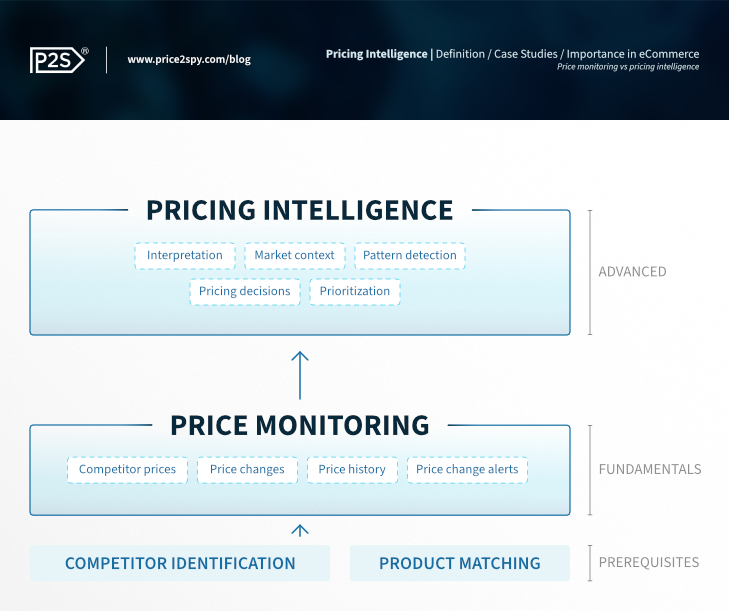
Pricing intelligence helps you understand why something (e.g. price, availability, discount percentage, etc) changed, how important it is, and what action makes sense.
For example, if a competitor drops the price of a product by 8%, that data point alone is not enough. You also need to know whether:
- the product is an exact match;
- other competitors are in stock;
- the lower price is part of a short-term promotion;
- multiple competitors are doing the same thing;
- the price drop affects one category or an entire brand portfolio;
- matching that price would hurt your margin unnecessarily.
Pricing Intelligence on a Practical Level
Besides the already mentioned price monitoring, having a reliable pricing intelligence system also requires:
- product matching across sellers/marketplaces;
- monitoring discounts and promotional pricing;
- identifying price trends over time;
- tracking price position within a market;
- spotting unusual changes and/or pricing anomalies.
In other words, pricing intelligence is not just about watching the market. It is about understanding it well enough to price with confidence.
Let’s now quickly take a look at how selected large retailers and brands utilized pricing intelligence to their advantage.
BIG W
For a large omnichannel retailer like Big W, pricing intelligence was essential to staying competitive in a market defined by frequent price and assortment changes across a wide product range.
Big W used Price2Spy for custom price and availability monitoring, daily alerts, and reporting, which helped its team focus on the most important market changes and maintain an up-to-date view of competitor activity.
“Price2Spy’s flexibility allowed us to really focus on the most important changes on the market and made the monitoring process a lot easier. The reporting mechanism is quite powerful and it helps us get an up-to-date overview of the market, anytime. And last, but not least, they have highly efficient support which is a pleasure to work with.” – Jay Matutina, Senior Pricing Analyst
Full success story: https://www.price2spy.com/big-w.html
EPSON
For a global manufacturer like Epson, pricing intelligence played a critical role in helping the company monitor multiple markets, track competitors across countries and product categories, and protect brand value at scale.
Epson used Price2Spy to centralize pricing data, monitor price violations, and access both live and historical pricing through dashboards, reports, and Excel exports, making it easier for teams across markets to work from the same reliable competitive insight.
“Epson introduced Price2Spy in December 2019 to track both our own and our competitors’ pricing across a range of different product categories and countries. Price2Spy has allowed us to share reports in a simple and functional format. Setting up dashboards has been easy and efficient and the ability to see live and historical pricing on one screen been invaluable. The Excel extraction function allows us to manipulate the data derived from the Price2Spy system easily and quickly. We are continually expanding the coverage and looking for new applications for Price2Spy across the business. “ – Douglas Noble, Data Insight Analyst
Read the full success story here: https://www.price2spy.com/epson.html
FRITEL
For a brand like Fritel, pricing intelligence was important not only for tracking competitor prices, but also for gaining a clearer view of how its products were distributed across retailers and markets in Europe.
As Fritel expanded across Belgium, the Netherlands, Germany, and France, it needed to monitor many products across 20 websites, which made frequent manual tracking difficult and limited visibility into pricing, distribution, and market strategy.
By using Price2Spy for continuous monitoring every six hours, automated reports for different markets and retailers, and centralized filtering by market, country, and category, Fritel gained a more structured, actionable view of the market.
“Price2Spy provides a complete overview of our product distribution and the strategy that is in the alignment with that.”
Read the full success story here: https://www.price2spy.com/fritel-belgium.html
Why Pricing Intelligence Matters in eCommerce?
Without competitive data, pricing teams are shooting in the dark. You could say there’s a fog of war effect at play. When operating solely based on your own costs, online retailers are relying more on luck rather than calculated decisions.
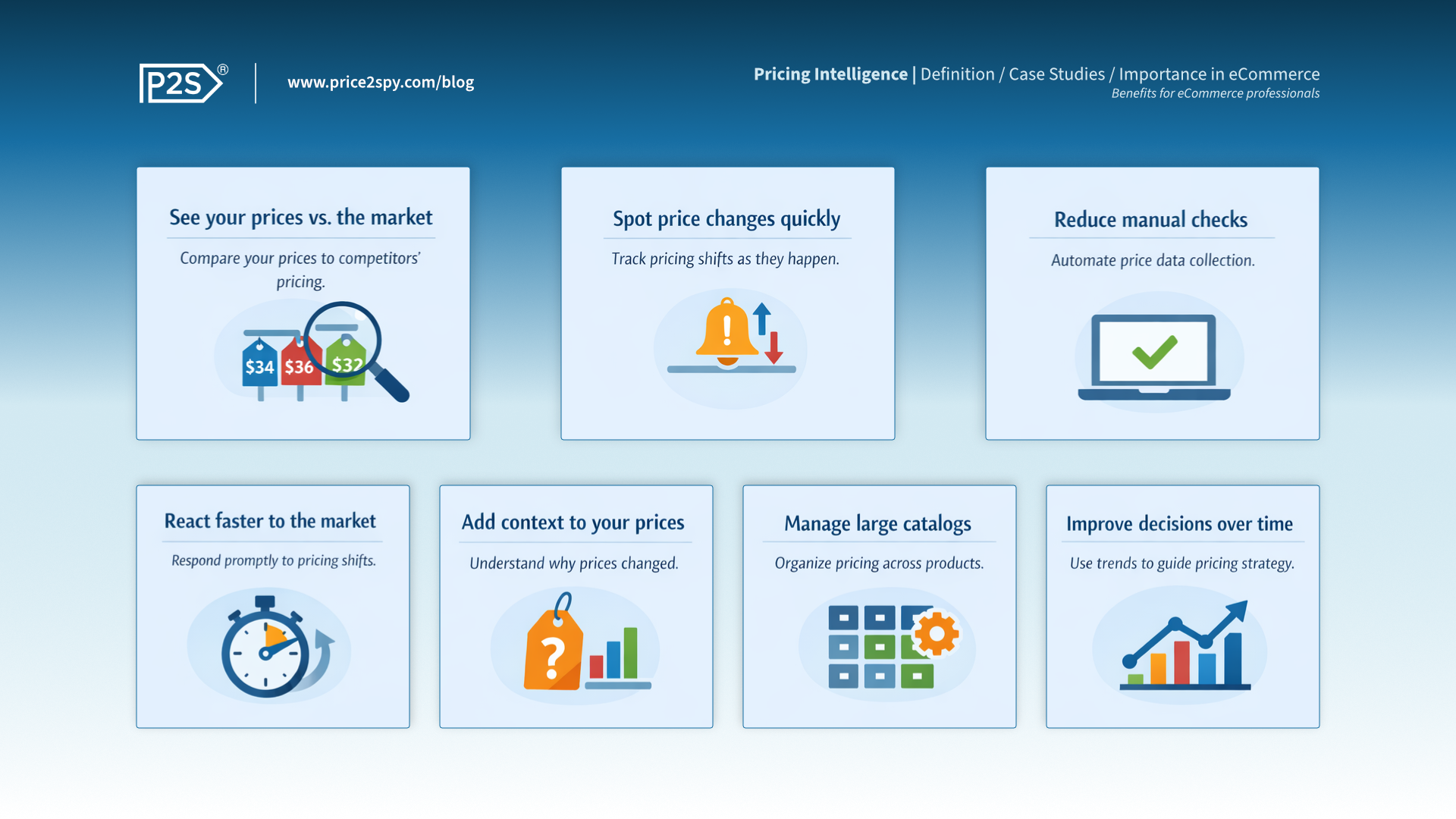
A perfectly legitimate question to ask now would be: what exact differences does having pricing intelligence make in eCommerce? Here are the most important ones:
- It helps businesses stay competitive without guessing, primarily by helping retailers see how their prices compare to the market.
- It reduces manual work and improves focus, and in turn saves time and clears up your schedule for more valuable work.
- It supports faster reactions to market changes by making promotions and other price changes visible sooner (usually through a custom system of alerts and notifications).
- It improves consistency across large catalogs. Many pricing and competitive intelligence tools offer different ways to organize the competitive data via various reports, charts, and customizable dashboards.
- It strengthens strategic decision-making, by steering away from decisions based on one-off occurrences and toward longer-term patterns.
How Pricing Intelligence Works (Step by Step)
While everything said sounds good, you may still be wondering how to actually approach pricing intelligence in practice. Firstly there are a few preparatory steps you need to take: competitor identification and product matching. Then, you start monitoring prices. By using the collected competitive pricing data you get insights that power your future repricing decisions.
Here’s a more detailed overview of that whole process:
- Identify the competitors you want to track: if you have been on the market for even a short while, you will likely already know who your direct competitors are. It’s a good idea to start from them, and focus on new or indirect ones later on.
- Match their products to your own: matching products means mapping equivalent products from your and your competitors’ websites in a matrix so their prices can be compared. It is a key step in both the price monitoring and pricing intelligence gathering processes.
- Monitor price changes: price monitoring is at the core of pricing intelligence. Gathering competitor pricing data enables every other competitive analysis down the road.
- Organize and analyze the data: this is the first step away from price monitoring and towards pricing intelligence. It consists of putting all the collected pricing data into a clear structure so it can be compared and reviewed more easily. This is where you sort through the information, check what is relevant, and start looking at how your prices stand against the market.
- Find patterns and insights: use the organized data from the step above to notice things that matter, such as repeated competitor price drops, changes in certain categories, or products where you are regularly priced too high or too low.
- Adjust your pricing when needed: this is the actionable step. Use the competitive pricing intelligence you have and combine it with your business goals and internal data to come up with prices that will balance out your margins on one hand, and attractiveness perceived by customers on the other.
Conclusion
Pricing intelligence is about understanding what is happening in the market and using that information to make better pricing decisions. In eCommerce, where prices change fast and competition is always visible, that kind of clarity does make a difference.
The process itself is not complicated in theory, but it does require structure. You need to know who you are comparing yourself to, make sure the right products are matched, and turn pricing data into something you can actually use. That is where pricing intelligence becomes more than monitoring. It becomes a way to spot what matters and act with more confidence.
Over time, this helps businesses work more efficiently, respond more carefully, and manage pricing with less guesswork. And when pricing is handled with that kind of consistency, it becomes much easier to stay competitive without losing control of your margins.