

Black Friday & Cyber Monday 2026: A Practical Guide for eCommerce Professionals
Black Friday and Cyber Monday represent some of the biggest sales opportunities of the year for eCommerce businesses. They also create an environment where pricing decisions, promotional timing, and product availability can directly affect profitability.
For retailers, success involves more than attracting customers with significant discounts. It requires understanding competitor activity, identifying products with the greatest sales potential, protecting margins, and responding to changes in demand.
This guide covers the key decisions eCommerce professionals should make before, during, and after BFCM, with practical recommendations for building a more effective and profitable strategy.
For a closer look at the numbers behind these shopping events, explore our Black Friday and Cyber Monday facts and statistics.

Before BFCM: Build a Strategy Based on Data
Preparation begins with identifying where the greatest opportunities lie and deciding how to approach them.
1. Define Your BFCM Objectives and Prioritize Products
Not every product needs the same promotional strategy, and not every promotion should have the same objective.
Some products can attract new customers, others can generate higher margins, while certain categories may require discounts to clear excess inventory.
Before finalizing promotions, consider:
- Revenue growth: Which products have the potential to generate the highest sales volume?
- Profitability: Which products can support discounts without significantly reducing margins?
- Inventory management: Are there slow-moving products that would benefit from promotional pricing?
- Customer acquisition: Which popular products could attract new customers who may make additional purchases?
For example, a consumer electronics retailer might offer aggressive discounts on selected popular devices to attract traffic while maintaining healthier margins on accessories and complementary products.
The objective is to create a promotional mix that supports business goals rather than applying discounts uniformly across the entire catalog.
2. Analyze Previous BFCM Performance
Historical sales data provides a useful starting point for planning.
Review previous campaigns to identify which products performed well, which promotions generated profitable sales, and where opportunities were missed.
Look beyond total revenue. A campaign that generates impressive sales figures may deliver disappointing results if discounts and fulfillment costs significantly reduce profitability.
Useful metrics include conversion rates, average order value, gross margin, inventory turnover, and promotional ROI.
It is also worth examining how demand changed throughout the promotional period. Did certain products sell better before Black Friday? Were some categories more successful on Cyber Monday? Did stockouts prevent additional sales?
These findings can help determine where to focus resources and how to distribute promotional activity across different days.
3. Understand Competitor Pricing Before Setting Discounts
Competitive pricing becomes particularly important during BFCM, when retailers frequently adjust prices to attract shoppers.
However, making pricing decisions based solely on competitors’ lowest advertised prices can quickly reduce profitability.
Start by identifying the competitors and products that have the greatest influence on your market position.
For each priority product, analyze:
- Current competitor prices and historical price movements
- Typical promotional patterns and discount levels
- Product availability across competing stores
- Shipping costs and delivery conditions
- Differences between advertised and final checkout prices
Historical pricing data can reveal whether a competitor typically offers significant Black Friday discounts or maintains similar prices throughout the holiday season.
This information helps businesses establish realistic pricing expectations and prepare appropriate responses before promotional activity intensifies.
4. Establish Pricing Rules That Protect Profitability
Once you understand the competitive environment, define how your business will respond to different pricing scenarios.
A useful starting point is to establish minimum acceptable prices based on product costs, target margins, and additional expenses.
Next, determine which products require highly competitive pricing and which can maintain a premium position.
Consider a retailer selling a product for $200 with a total cost of $150. Reducing its price by 20% would bring the selling price to $160, leaving just $10 before other operating expenses.
Although the discount may improve competitiveness, it could significantly reduce the profit generated by each sale.
This is why pricing decisions should consider both competitive positioning and financial performance.
Automated repricing can help businesses apply predefined pricing rules across large product catalogs. However, these rules should include safeguards such as minimum prices, margin thresholds, and clear conditions for responding to competitor changes.
The goal is to remain competitive while maintaining control over profitability.
5. Plan Promotions Around Customer Demand
Black Friday promotions increasingly extend beyond a single weekend, making timing an important part of promotional planning.
Rather than launching every discount simultaneously, retailers can distribute offers across different stages of the shopping period.
Early promotions may help attract customers researching products before Black Friday. More competitive offers can be reserved for high-demand shopping days, while selected promotions may continue after Cyber Monday.
Promotional planning should also account for product categories.
For example, a 20% discount on a popular laptop can have a strong impact on purchasing decisions because shoppers can easily compare prices for the same model across multiple retailers. Furniture purchases, however, often involve additional considerations such as delivery costs, assembly services, and product customization. In this case, free delivery or assembly may provide greater value to customers than an additional price reduction.
Depending on the product category, retailers can combine price reductions with incentives such as product bundles, loyalty rewards, or limited-time offers. These approaches can increase the perceived value of a promotion while helping businesses protect their margins.
6. Prepare Inventory and Fulfillment Operations
An attractive discount has limited value if the product becomes unavailable or delivery expectations cannot be met.
Inventory planning should therefore be closely connected to promotional strategy.
Use historical demand and current sales trends to estimate which products are likely to experience increased demand. Coordinate with suppliers and fulfillment teams to ensure sufficient stock and realistic delivery commitments.
Pay particular attention to products featured in paid advertising campaigns, email promotions, and homepage banners.
If a promoted product sells out, businesses should be ready to adjust their campaigns, recommend alternatives, or redirect attention toward available inventory.
Delivery costs and estimated arrival times also deserve attention. Customers comparing similar products may choose a slightly more expensive offer if it includes faster or more convenient delivery.
A competitive BFCM offer is defined by the overall purchasing experience, not just the product’s advertised price.
Subscribe to our newsletter!
Latest pricing news, eCommerce updates and more!
During BFCM: Monitor the Market and Respond Strategically
Once promotional campaigns begin, the focus shifts from planning to execution.
Competitor prices, inventory availability, and customer demand can change quickly. Businesses need reliable information to determine whether their initial strategy remains effective.
7. Monitor Competitor Prices and Promotions
Competitor monitoring should continue throughout the promotional period, particularly for high-demand products and categories.
Track price changes, promotional offers, stock availability, and other factors that influence purchasing decisions.
Frequent monitoring helps identify important developments, such as a competitor introducing an unexpected discount or increasing prices after a popular product sells out.
However, collecting information is only the first step. The real value comes from understanding which changes require action.
For example, a competitor reducing a product’s price by 15% does not automatically mean your business should match that discount.
Before responding, consider whether the competitor has sufficient inventory, whether the products are directly comparable, and whether matching the price would support your commercial objectives.
8. Know When to Match a Competitor’s Price
One of the most important BFCM decisions is determining when a competitor’s price change justifies a response.
Consider the following scenario.
A retailer sells a popular household appliance for $250. A major competitor reduces its price to $220 during Black Friday.
Matching the discount may seem like the obvious choice, particularly if the product is highly price-sensitive.
However, several factors should influence the decision.
If the competitor charges an additional $20 for shipping while your store offers free delivery, the difference in total cost is considerably smaller than the advertised prices suggest.
Similarly, if your business offers faster delivery, better warranty conditions, or additional services, maintaining a slightly higher price may be justified.
On the other hand, if the competitor offers an identical product with similar delivery conditions and sufficient inventory, a price adjustment may be necessary to protect conversion rates.
The right response depends on the overall offer, not simply the lowest visible price.
9. Use Competitor Stock Availability to Your Advantage
Competitor stockouts can create valuable pricing opportunities during periods of high demand.
When a competitor runs out of a popular product, shoppers may turn to alternative retailers.
Businesses that continue to offer the product may be able to maintain their current price rather than introduce additional discounts.
In some situations, a carefully evaluated price increase may also be appropriate, provided it aligns with demand, competitive conditions, and customer expectations.
For example, if several competing stores run out of a popular gaming console, a retailer with available inventory may have less reason to participate in aggressive discounting.
This approach requires accurate stock information and a clear understanding of market conditions.
Monitoring competitor availability alongside pricing helps businesses identify opportunities that price comparisons alone might miss.
10. Coordinate Pricing, Marketing, and Inventory Teams
BFCM campaigns depend on several business functions working toward the same objectives.
Marketing teams need accurate information about active promotions and product availability. Pricing teams need visibility into campaign performance and competitor activity. Inventory teams must communicate potential stock shortages and fulfillment limitations.
Without coordination, businesses risk promoting unavailable products, advertising outdated prices, or maintaining discounts that no longer support profitability.
Establish a simple process for sharing important updates during the promotional period.
For example, if a competitor introduces an aggressive discount on a heavily promoted product, the pricing team can evaluate whether a response is justified. Marketing can then adjust campaign messaging if necessary, while inventory teams confirm that sufficient stock is available.
Clear responsibilities and timely communication help businesses respond more efficiently without making unnecessary changes.
After BFCM: Evaluate Results and Improve Future Campaigns
The end of Cyber Monday does not mean the work is finished.
Post-campaign analysis provides an opportunity to understand which decisions generated value and where future strategies can improve.
11. Measure Performance Beyond Revenue
Revenue is an important indicator of campaign performance, but it does not provide a complete picture.
A successful BFCM strategy should balance sales growth with profitability, customer acquisition, and operational efficiency.
Evaluate metrics such as:
- Gross profit and margin: Did increased sales generate sufficient profit after discounts?
- Conversion rate: Which products and promotions converted visitors most effectively?
- Average order value: Did bundles or complementary products increase basket value?
- Customer acquisition cost: How efficiently did marketing campaigns attract new customers?
- Inventory performance: Which products sold out, and which remained overstocked?
- Return rates: Did certain promotions lead to higher-than-usual returns?
Comparing these metrics across product categories and promotional periods can reveal patterns that are not immediately visible in overall sales results.
12. Turn BFCM Insights Into Better Pricing Decisions
BFCM generates valuable information about customer demand, competitor behavior, and price sensitivity.
Instead of treating this information as relevant only to the holiday season, use it to improve ongoing pricing strategies.
Identify which competitors consistently offered the lowest prices, which products were most sensitive to discounts, and where your business successfully maintained higher margins.
Review whether pricing rules performed as expected and whether any automated adjustments produced undesirable outcomes.
It is also useful to examine how stock availability affected pricing opportunities and whether delivery conditions influenced purchasing decisions.
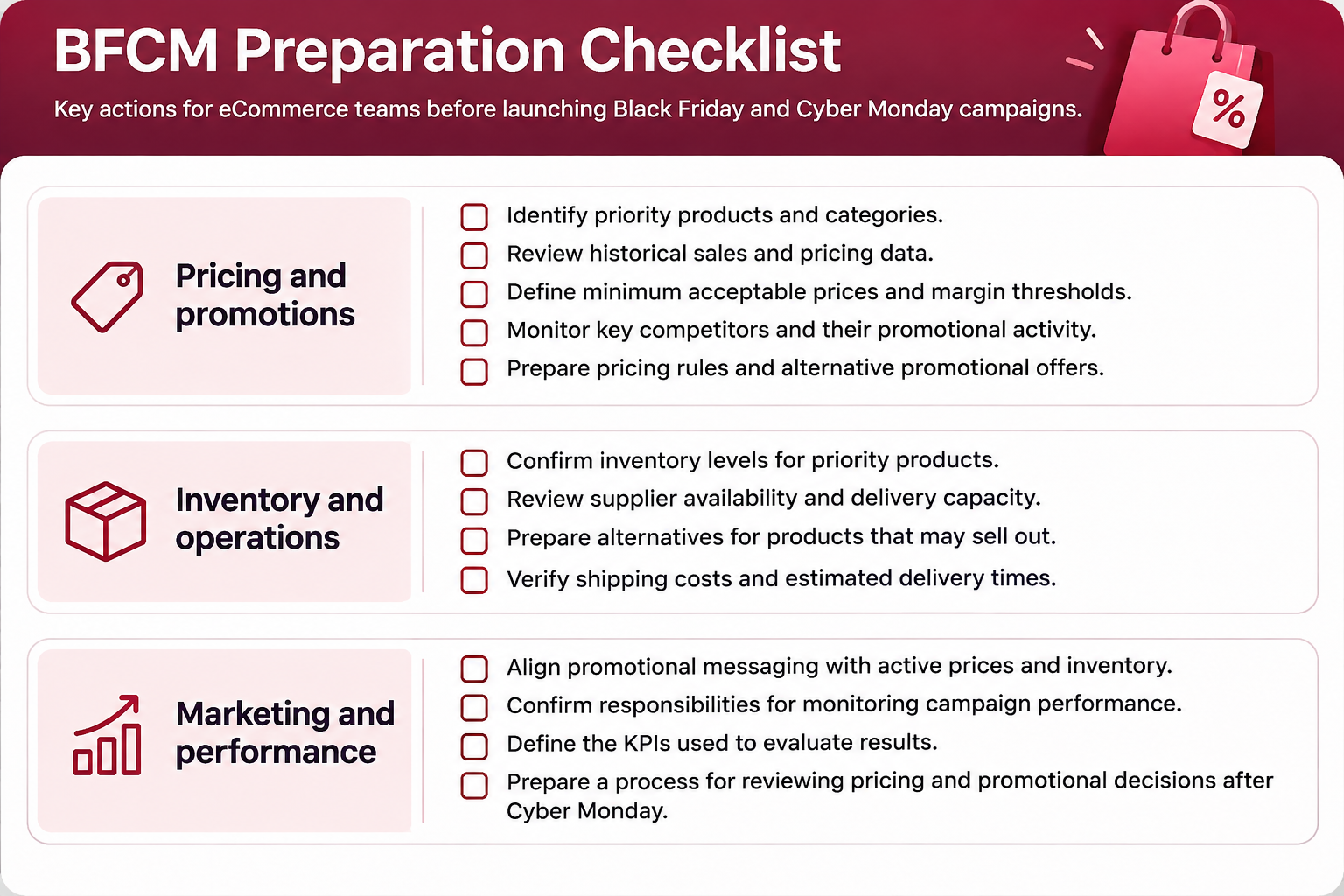
BFCM Preparation Checklist for eCommerce Teams
Before launching your Black Friday and Cyber Monday campaigns, make sure you cover the essential elements.
Make Every BFCM Pricing Decision Count
Black Friday and Cyber Monday create opportunities to increase sales, attract new customers, and strengthen market positioning. However, achieving these results requires more than offering competitive discounts.
Businesses that combine historical data, competitor intelligence, careful promotional planning, and continuous performance monitoring are better positioned to make informed decisions throughout the shopping period.
The most effective strategy supports customer demand while protecting long-term profitability.
With the right preparation and reliable market information, eCommerce teams can approach BFCM with greater confidence and turn short-term promotional activity into lasting business value.